What Is Speech Therapy for Children? A Parent’s Ultimate Guide to Communication Support
You have been hearing about speech therapy since you started noticing your child may not be talking as much or as well as their peers. Maybe you have seen lots of videos on Instagram. It is enough to confuse even the brightest minds.
Contents
If you’ve ever watched your child struggle to say what they mean…
If they point, cry, or give up when they can’t make themselves understood…
Or if they repeat lines from cartoons but rarely speak in their own words, you’re not alone. And more importantly, you don’t have to wait and wonder. Speech therapy might be the gentle, powerful support your child needs to find their voice.
This post is to help you understand what speech therapy is, and it can help your child speak more clearly. You will also learn how and why it works (or does not work for some people). Lastly, you will learn what to do to make it the best treatment for your child.
What Is Speech Therapy for Children? Definition & Purpose
Speech therapy is any treatment intended to relieve or heal a speech disorder. In other words, speech therapy is a specialised form of support for children (and adults) who have difficulty with communication. This treatment may include different approaches to treat different issues, including:
- Speech delays (not talking by expected ages)
- Language delays (not understanding or using words)
- Childhood Apraxia of Speech (CAS)
- Autism-related communication challenges
- Echolalia (repeating phrases instead of using original language)
- Frustration during attempts to communicate
How Speech Therapy Works for Kids: Personalised Plans That Actually Help
There are many different types of speech therapy, and there is no one-size-fits-all approach for every case. You see, a good speech therapist works with you to create an appropriate treatment plan for you. This plan will be based on the specific needs you may have to improve your communication skills.
Speech therapy exercises and activities differ depending on your child’s disorder, age, and needs. For example, we can create several plans at several stages of your child’s therapy. This program plan will account for all the new needs as they arise.
For instance, a child with ADHD will have a different program from a child with speech delay. A child with autism will have a different program. So will a child with echolalia. The approach will also include drills, play activities and routines.
A good speech therapy program also includes changes to your child’s diet, their sleep routine and their connection with you.
If you work with Caston Vienna Tutors, for example, all of these will be a part of your program, as every session includes parent involvement and take home practice to do with your child when the therapist is gone. You will also get different new natural foods to add to your child’s diet to help them.
We use different activities to stimulate language development. And we also interact through talking and playing, and we use books, pictures, and other objects as part of language intervention.
We teach your child to make certain sounds, model correct sounds and syllables using age-appropriate play.
What kind of therapy do I need?
Consult a speech therapist. Please, I beg you. Do not use the internet to self-diagnose your child’s speech issues. Any information you find on the internet is general information for educational purposes only. Please don’t take it as an assessment.
Any speech therapist worth her salt is going to assess your child’s speaking before planning their therapy program and/or telling you what to do at home.
Please trust me when I say that a speech therapist who sees you and hears you in person is going to do a better job than anyone on the Internet when it comes to advising you about your issues.
Does Speech Therapy Work? Evidence + Real Results for Nigerian Families
My answer is YES.
I know how this may sound, but I am asking for customers. But hear me out.
Let us first ignore the many children we have helped to start communicating well. Ignore the number of children that speech therapy has helped generally. Then let us come home.
Speech therapy is effective because it treats the root cause of the problem. Many times, a child may have gut imbalance, disconnect at home, trauma, or autism. Speech therapy will help treat these issues while assisting the child to make sounds, reduce their possible sensory overload, communicate (with or without words), and play with other children.
This treatment may include changes in your child’s diet, sleep patterns, your routines with them, and even their schooling.
Let us take a case study.
Who Benefits from Speech Therapy? Conditions We Treat in Children
A good Speech and Language Therapist has a deep working knowledge of Phonetics. In fact, one of the prerequisites to speech therapy training is linguistics. I was an early years phonics teacher for about 4 years before my training in Speech Language Pathology.
Now, a speech therapist with good knowledge of phonetics can improve a child’s pronunciation.
For example, let us look at a child with language issues. That means the child is having issues pronouncing certain sounds. How can speech therapists help?
How Speech Therapists Help Children Speak Clearly: 3 Key Techniques
First, a speech therapist will help your child with drills in word sound contrasts (lip/rip, glow/ glove, pour/four, free/three). This will ‘fine tune’ or sharpen the child’s ability to hear errors in others and in time, hear their own errors. So, the first stage is aural discrimination. We can not move on to the next stage until the phonetic ear is sharpened.
Second, speech therapy will help the child to PLACE their articulators (lips, teeth, tongue, soft palate, vocal cords). The therapist will teach the child about HOW to release each sound in the mouth. They also train the child to hear and make differences in sounds.
Third, speech therapy will help the child place the syllable and word stress correctly. We all know children who have good grammar, a vast vocabulary but no one understands a word they are saying! This is because no one taught them how to move from syllable timed rhythm to stress timed rhythm. It makes a world of a difference. A Speech and Language Therapist has the skills to help.
Why Speech Therapy Sometimes Fails (And How to Avoid It)
I will use this segment as a big “don’t take my word for it.”
I want to show you screenshots from a forum. Here are actual recipients of speech therapy and what they had to say about why some people’s speech therapy is not working but it is working for others.
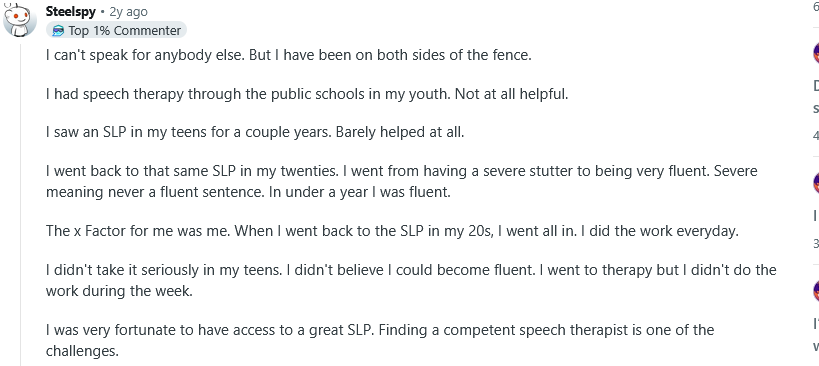



Okay, now what have you seen from these screenshots?
The most consistent factor is that when speech therapy does not work, it is the fault of the recipient. Whether you are a child or an adult, no one can take a treatment for you. For instance, with child speech therapy, the child and the parents, or guardians, must agree that they want speech therapy and that the treatment will help them. They must never plant doubts in their minds or the child’s.
Second, you will get take-home practices. You must judiciously do these activities at home. You must ensure that you follow through. Otherwise, all will be for nothing.
We have had parents who stopped therapy with us because they weren’t seeing results. The real reason they weren’t seeing results was them. They are not following through.
How to Assist Your Child’s Speech
See a speech therapist. They will assess your child’s speech and give you professional recommendations. Whether you are in Port Harcourt, Lagos, or Abuja, you can work with a qualified speech therapist who understands the Nigerian context, like Caston Vienna Tutors. We will help you create a bespoke program for your child.
FAQ
These are some questions many Nigerian families ask, and how we answer them.
Q: How long does speech therapy take to show results?
A: It depends on what you mean by results. Children show changes in behaviour, attitude to learning, and so on by the end of the first week of therapy. The period to see big results varies by child. Some children show progress within 4–6 weeks; others may need 6–12 months of consistent sessions. The biggest factor is how consistently parents follow through with home practice.
Q: How much does speech therapy cost in Nigeria?
A: Costs vary by provider and city. In Lagos, Port Harcourt, and Abuja, private speech therapy sessions typically range from ₦15,000 to ₦50,000 per session. At Caston Vienna Tutors, we offer personalised programs. You can see our pricing on our speech therapy page.
Q: At what age should a child start speech therapy?
A: The earliest, the best. Children as young as 12–18 months can benefit from early intervention. If your child is not babbling by 12 months or not saying words by 18 months, speak to a speech therapist.
Q: Can speech therapy help a child with autism?
A: Yes. Speech therapy is one of the most effective supports for autistic children. It helps with functional communication, reducing echolalia, building social language, and managing sensory-related communication barriers.
Q: Can I do speech therapy at home?
A: Home practice is a critical part of therapy, but it should complement—not replace—sessions with a qualified therapist. Your therapist will give you specific exercises to do at home between sessions.
Q: Is speech therapy available in Port Harcourt?
A: Yes. Caston Vienna Tutors offers speech therapy in Port Harcourt, with programs tailored to each child’s needs. We also offer consultations for families in Lagos and Abuja.